




Building a Data Platform: 7 Key Architectural Mistakes We Would Never Make Again
⏱️ Reading time: approx. 8 minutes
Building a modern data platform is not a one-off IT project but a continuous process that must flexibly support business growth. Unfortunately, in engineering practice the line between a flexible architecture and costly chaos can be remarkably thin. At Alterdata, we have delivered more than 60 custom data platforms for mid-market companies and digital natives. Instead of pure theory and recycled marketing slogans, we share hard-won lessons from our implementations.
In this article, a continuation of our series on the strategic development of data environments, we present the most common architectural mistakes we would now avoid at all costs. Discover lessons drawn directly from production projects.
1. Overengineering and building “just in case”
One of the most common sins at an early stage of development is designing overly complex structures in advance. Instead of focusing on delivering business value as quickly as possible (Time-to-Value), architecture teams give in to the temptation of building systems designed for extremely large data workloads (Big Data) before the organization even needs them.
An overly elaborate architecture at the outset can mean higher infrastructure and maintenance costs, more difficult onboarding of new engineers, and greater process complexity. In hindsight, we know that architecture should evolve gradually, in step with changing business needs. In many cases, a good solution is to use proven analytical technologies such as Google BigQuery, with a clearly defined separation into data layers. This makes it possible to build solid foundations for the platform without deploying unnecessary components from the start.
In practice, this means that not every organization needs to invest right away in an extensive Data Lakehouse ecosystem or additional data processing tools. Often, a simple data warehouse that integrates the most important sources and enables consistent reporting is enough. Expanding the architecture should stem from specific needs, such as a growing processing scale, real-time analytics requirements, or the need to support more complex analytical and AI processes.
2. Streaming everywhere, even where batch is enough
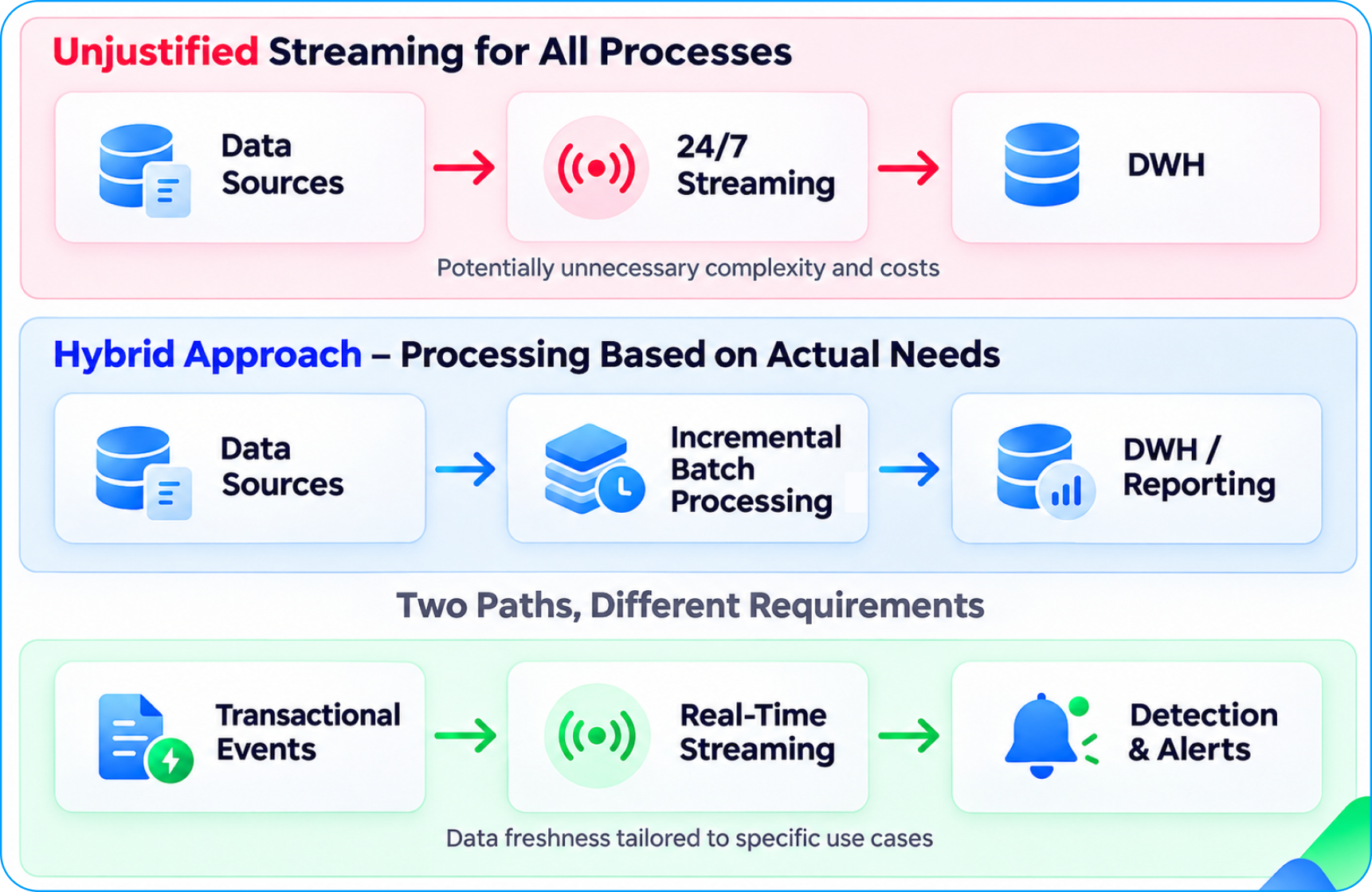
Real-time data processing (Real-time Streaming) sounds attractive in business presentations. However, replacing classic batch processing with full stream processing can significantly increase architectural complexity and maintenance costs. Continuous data processing requires proper event flow management, error handling, and process monitoring. That is why the choice of approach should be driven by real business needs, the required data freshness, and the expected system response time, not by technological trends.
In business practice, for many KPIs and management reports, updating data every few hours or even once a day is sufficient. In such cases, batch processing, including an incremental model, can be a simpler and more cost-effective solution. Streaming is worth implementing where delays in access to information genuinely affect how the organization operates, for example in financial fraud detection, operational process monitoring, or responding to events in real time. Modern platforms such as Google BigQuery make it possible to combine different data delivery methods within a single analytical environment. As a result, an organization can match processing frequency to the needs of specific processes instead of building a costly streaming architecture for the entire ecosystem.
3. Excessive bureaucracy in Data Governance
Data Governance should be an integral part of a data platform from the very beginning of its construction. Clearly defined responsibilities, access rules, basic quality rules, and documentation of key assets help ensure the security and consistency of information. This does not mean, however, that elaborate procedures, multi-stage approval processes, or detailed cataloging of every dataset must be implemented right away. The scope of these activities should match the scale of the platform, its complexity, and the organization’s real needs.
Excessive formalization of processes can have the opposite effect to what was intended, making day-to-day work with data harder. The most common consequences are:
- Loss of agility: Analysts and engineers spend more and more time on formalities and obtaining approvals instead of focusing on delivering business value.
- Emergence of a “grey zone”: Overly complicated procedures can push business teams to create their own spreadsheets and independent reports outside the central data platform. This increases the risk of inconsistent information, divergent metric definitions, and data being shared outside the established access control rules.
- Inefficient use of resources: Thoroughly documenting every temporary dataset that will soon change structure or cease to exist creates extra work without proportional benefits.
As the platform grows, it is worth gradually extending Data Governance with more advanced mechanisms for cataloging, metadata management, quality monitoring, and data lineage tracking. Tools such as Google Cloud Knowledge Catalog can support these efforts and reduce the need for manual management of asset information. Most importantly, however, the development of Data Governance should stem from concrete needs, and the mechanisms put in place should make working with data easier rather than creating new organizational barriers.
4. Lack of cost control over the data platform
The Pay-As-You-Go model allows flexible use of cloud resources, but without proper oversight it can lead to unexpected expenses. Unoptimized queries, repeatedly processing the same data, unnecessarily running resources, or a poorly chosen pricing model can cause the platform’s maintenance costs to grow faster than its business value.
That is why cost control should be considered as early as the architecture design stage. The foundation should be setting budgets for individual projects or environments and configuring alerts that notify you when spending approaches defined thresholds. The tools available in Google Cloud Billing make it possible to monitor budget usage and respond to worrying cost increases. Equally important are regular analysis of resource consumption, optimization of queries and processing pipelines, and a conscious choice of pricing models.
Cost management should not be a one-time action taken only after receiving a large invoice. It is an ongoing part of maintaining and developing the platform that helps maintain a balance between performance, scalability, and the cost-effectiveness of the entire solution.
5. Unintentional dependence on a technology vendor (Vendor Lock-in)
Choosing a cloud provider and the technologies used to build a data platform is a decision that affects its future development potential. Using native services such as Google BigQuery is not a mistake in itself. Quite the opposite: it reduces infrastructure complexity, speeds up implementation, and makes use of ready-made scaling mechanisms. The problem arises when an organization builds up more and more technological dependencies without being aware of their long-term consequences.
The more key processes rely on solutions specific to a single vendor, the more difficult and costly their later migration or integration with other environments may turn out to be. That is why, already at the design stage, it is worth consciously assessing which elements of the architecture may be tightly coupled to the chosen platform, and where it makes sense to use open standards, popular data formats, or solutions that allow code to be reused.
The goal should not be to eliminate Vendor Lock-in entirely at any cost. Such an approach often leads to unnecessarily complicating the architecture and giving up the benefits offered by native services. Far more important is the conscious management of dependencies, documenting key processes, and preserving the ability to develop the platform without having to rebuild the entire environment with every technological change.

6. No clearly defined ownership of data
Even the best-designed data platform can quickly lose credibility if the organization lacks a clear division of responsibility for the quality and maintenance of source data. Handing all responsibility over to a central data engineering team is a trap: engineers are responsible for the technical aspects of data processing, but it is the owners of source systems and business teams who best understand the data’s origin, meaning, and how it is used.
At the very start of building the platform, it is worth establishing who is responsible for individual data sources, their quality, and communicating planned changes. As the environment grows, with an increasing number of integrations and teams using the data, organizational agreements alone may no longer be enough. Changes to the structure or meaning of source data, introduced without the knowledge of the team responsible for the platform, can lead to pipeline failures, transformation errors, and incorrect reports.
In more complex environments, it is therefore worth considering the implementation of Data Contracts, which formalize requirements for the structure, quality, and availability of data, as well as the rules for communicating changes. They do not need to cover all sources at once; a good approach is to start with the integrations of greatest business importance. Equally important is building a culture of ownership in which source system owners treat the data they share as a product, ensuring its quality and predictability for other platform users.
7. Implementing AI without well-organized data foundations
The rapid development of artificial intelligence is prompting many companies to deploy AI agents and conversational analytics before properly preparing their data environments. Yet a lack of consistent business definitions, adequate data quality, and context for models can lead to flawed analyses and unreliable answers. AI can significantly accelerate work with information, but on its own it does not solve problems related to data quality and interpretation.
Before deploying AI that uses an organization’s data, it is worth taking care of three key elements:
- A consistent semantic layer: Unambiguously defined metrics and business concepts allow AI models to interpret data correctly and reduce the risk of inconsistent answers.
- Data quality control: Automated tests, schema validation, and monitoring of the completeness and timeliness of information help limit errors at later stages of processing. Data used by AI solutions should be properly prepared and verified for the specific use case.
- Business context for models: Table and column descriptions, business glossaries, and verified queries help AI agents interpret information correctly. Combined with access to the right data sources, this makes it possible to better ground generated answers in facts (grounding) and limit the risk of misinterpretation.
Summary and next steps
Thoughtfully building a data platform is not about deploying as many technologies as possible, but about choosing solutions that match the organization’s real needs. Avoiding excessive complexity, controlling costs, clearly dividing responsibilities, and properly preparing data make it possible to build environments that support business growth and future AI deployments.
Are you planning to expand or modernize your company’s data architecture? Consult the experts at Alterdata to discuss your company’s needs and book a free consultation. Benefit from the experience of a team that has delivered more than 60 successful analytics and cloud projects.