







Data Integration: How to tame the chaos in today's enterprise architecture?
⏱️ Reading time: approx. 6–8 minutes
Imagine a morning board meeting at a fast-growing company. The topic: budget decisions for the next quarter. The Marketing Director pulls out their report, the Sales Director presents their own spreadsheet, and the Finance Director is looking at a completely different summary from the ERP system. The result? Instead of a substantive discussion about strategy, half the meeting turns into an argument over whose margin figures and whose data are “more accurate.”
This scenario is not fictional, it is the everyday reality of many organizations that are growing faster than their analytics ecosystem. As the number of applications, CRM systems, e-commerce platforms, and transactional databases increases, and companies need to integrate data from different sources and systems, data source integration is no longer a technical luxury. It becomes a business necessity and the foundation for creating a unified view that supports informed business decision-making.

Why does traditional data integration generate hidden costs?
When the business needs reports “yesterday,” the simplest and most natural organizational response is immediate firefighting. Analysts quickly write new scripts, add more recurring SQL queries, and create increasing numbers of individual reports in spreadsheets or BI tools. Alternatively, companies turn to generic third-party tools for data integration. However, they often do so without deeper consideration of the target cost model, architecture, and the company’s actual needs.
Suddenly, a small Python script that used to extract data from 10 tables in 15 minutes has to handle many more pipelines and takes 4 hours to process the data. Every transmission error requires the entire process to be restarted, while poor data quality further compounds problems with data analysis and increases the risk of incorrect decisions. In addition, unexpected changes in the database structures of external providers can cause sudden spikes in cloud costs, as the system has to reprocess huge volumes of data from scratch, making ongoing data access more difficult and limiting effective management.
As the number of applications, CRM systems, and external platforms grows, data integration means combining data from multiple sources into a single unified view for decision-making. Without a clear data management strategy, fragmented initiatives can lead to weak data governance, insufficient access control, and greater risks related to data privacy. Without a well-thought-out data source integration strategy, the integration process should not be treated as a one-off project, but rather as an element of continuous data management.
Modern Data Integration from various sources: How to build a Single Source of Truth
The bridge between the chaos of data silos and the vision of a data-driven business is a scalable data architecture, while the data integration process is a key element of effective management and of building a consistent information environment. In modern data management, this often involves modern data architectures and operating models such as data fabric or data mesh. Data availability plays a key role here, as it supports analysis, the development of environments such as a properly designed data warehouse, and efficient reporting across the entire organization, while a well-designed data warehouse architecture helps structure access and processing layers.
At Alterdata, we approach this process methodically, keeping in mind that no single system or database can address all of an organization’s integration needs. We therefore divide it into complementary layers:
1. Data Collection and Storage
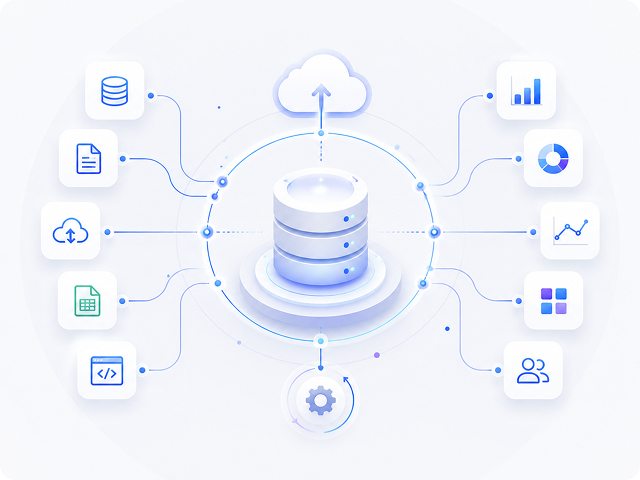
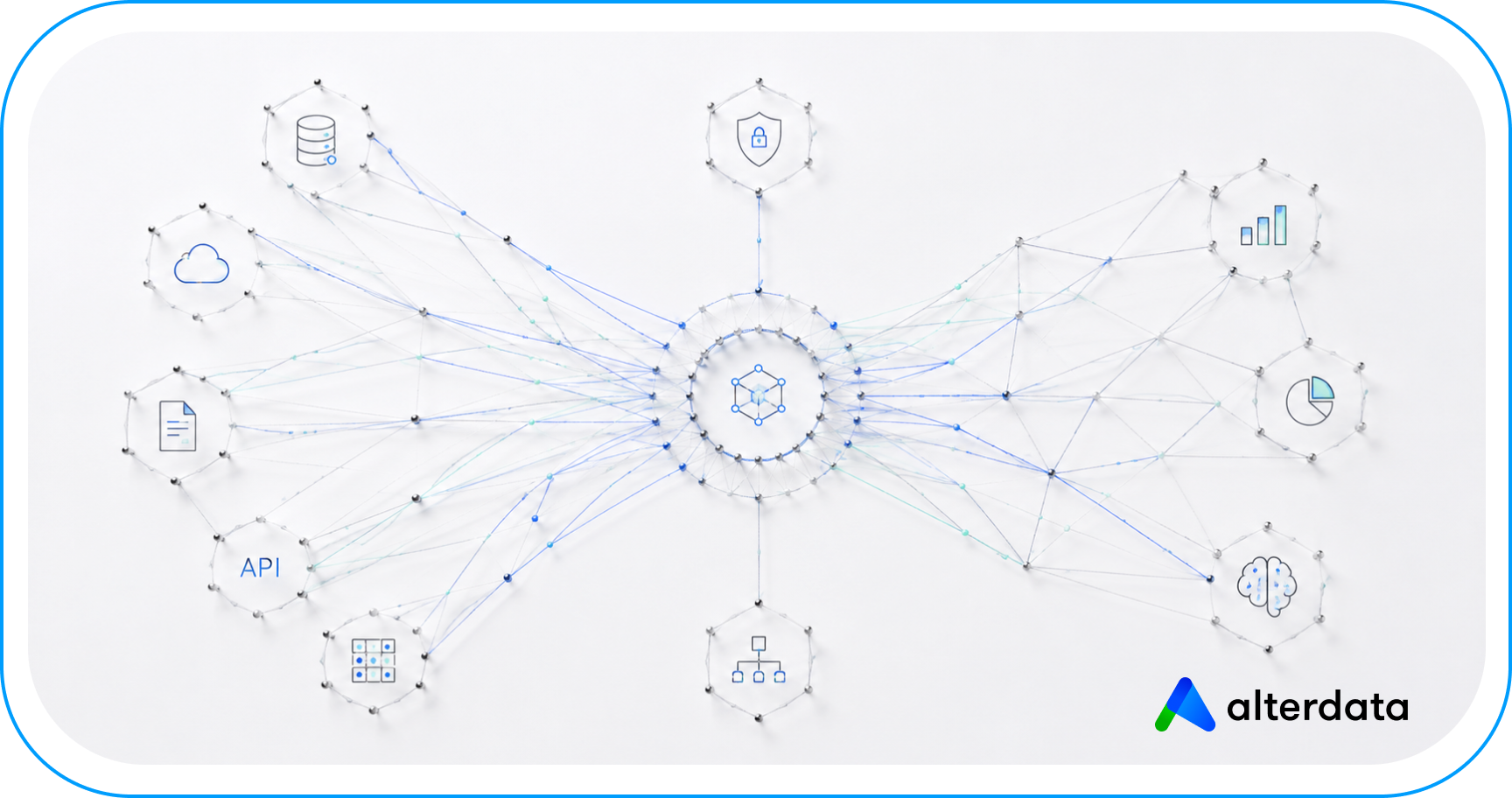
SRaw data and its ingestion from sources such as ERP systems, CRM platforms (e.g. HubSpot), or Google Analytics 4 represent the first stage of modern data management. The goal is to ensure a consistent and scalable flow of information from multiple data sources, systems, and formats into an environment where it can be securely stored and further processed.
Depending on the chosen architecture, data may be stored in a data lake, an object storage layer such as Google Cloud Storage, or directly in a data warehouse, such as Google BigQuery. The solution should be tailored both to the type and volume of data and to how the organization plans to use it later.
At Alterdata, we select the architecture and integration pattern based on the specific business and technology context. In more complex environments, approaches such as data fabric can support the integration of distributed systems, while data mesh helps structure data ownership across business domains.
2. Transformation, Data Management, and Semantic Model (Dataform)
Simply storing data in the cloud does not mean it is ready for business use. The next stage is to clean, standardize, combine, and model the data in line with the organization’s business logic, creating consistent and reliable datasets that are ready for further analysis.
This process can be carried out using either an ETL or ELT model. In ETL, data is transformed before being loaded into the target system, while in ELT it is loaded first and transformed afterwards using the computing power of the cloud environment. In modern data platforms, the ELT approach enables efficient processing of large data volumes without moving transformation logic outside the analytical environment, especially when supported by scalable cloud platforms.
Tools such as Dataform enable centralized management of transformation logic, SQL code versioning in Git, and documentation of data provenance (data lineage). This helps maintain consistent data models, control changes, and more easily trace how individual metrics are calculated. A well-designed data warehouse project should also take into account the needs of end users, store historical data, and support data quality management as part of a broader data warehouse architecture.
The result of this stage is structured and reliable data that can be safely used by analysts, business teams, and BI and AI solutions.
3. Data Sharing and Decision Support (BI and AI)
Structured and reliable data can then be made available to business users and applications in a form tailored to their needs. At this stage, the key priority is to ensure easy and secure access to data and to use it effectively in reporting, analytics, and decision-making processes.
Data can power Business Intelligence tools such as Looker Studio or Tableau, as well as AI- and machine learning-based solutions. Depending on the organization’s needs, access can also be provided through APIs, data streaming mechanisms, or solutions that enable information from multiple systems to be analyzed without the need to physically move it each time.
However, effective use of BI and AI depends on appropriate data quality. Consistent definitions, quality controls, and reliable data models reduce the risk of incorrect analyses and allow users to make decisions based on current and trusted information. As a result, data stops being merely a technical resource and becomes a real source of support for both day-to-day and strategic business decisions.
An important market lesson: the success of AI and Business Intelligence projects depends 80% on data quality and processes, and only 20% on the technology itself. If you feed AI inconsistent documents full of duplicates, the result will be hallucinations and incorrect conclusions. Raw event logs are difficult for business users to interpret, which is why solutions designed to improve data quality standardize, parse, and validate data before it is consumed. A solid data foundation also supports machine learning models and leads to better decision-making in advanced analytics and for data scientists.
Case Study: How Loconi organized its data and automated operational reporting
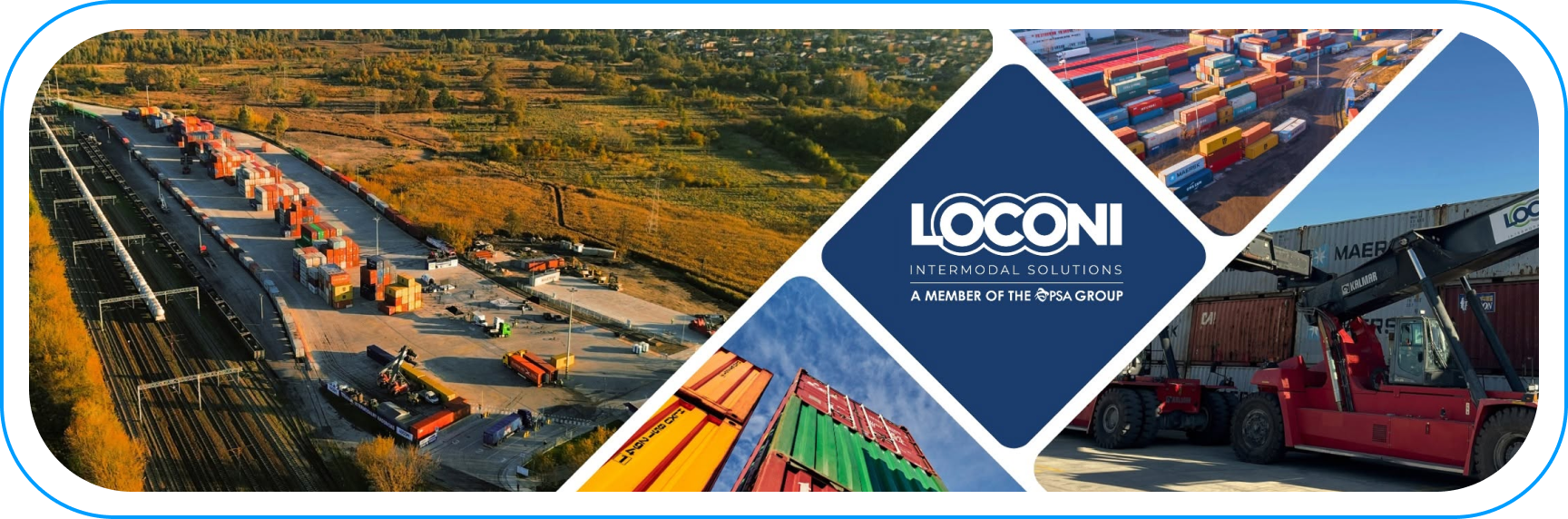
An excellent example of putting these principles into practice is the transformation carried out for Loconi Intermodal S.A., one of the key logistics operators. The organization faced the challenge of integrating dispersed operational data from ERP systems and Intense financial and accounting systems in order to gain access to automated, error-free analysis of P&L metrics.
Alterdata engineers supported the client by configuring a continuous data replication process from a SQL Server database to the Google BigQuery data warehouse using Kafka Connect. The next step was to reconstruct the distributed business and logistics logic and move it directly into the Dataform modeling environment. This made it possible to standardize ETL processes and create clear management dashboards in Looker Studio.
The implemented data source integration delivered immediate results:
- Reduced refresh time for operational and financial data from 24 hours to just 5 minutes.
- Data democratization – key teams across the organization gained intuitive, up-to-date access to a single source of truth for the company’s performance metrics.
- Automated monitoring of data quality and analytical pipeline stability through alerts implemented in Cloud Monitoring.
As a result, Loconi Intermodal S.A. gained a solid, automated foundation for building an internal analytics team and supporting further business expansion. Learn more about the case study.
How can you get started with data integration in your company? Start with a data integration strategy and tools
Remember: technology is only a tool for achieving a goal. The key to effective data source integration is asking the right business questions before purchasing cloud licenses. The right solutions are essential for effective information management and for selecting the appropriate tools, including data integration tools that support data warehouse design and process automation. You need to know which decisions you want to make faster, which end users you are supporting, and where your teams are losing the most time, because the solution should be driven by real business needs. In logistics, supply chain optimization requires immediate access to data.
Instead of integrating the entire IT ecosystem at once, choose one critical area and start with data distributed across different systems, from operational systems such as ERP or CRM to data from business applications. You can focus, for example, on customer journey analysis or automating access to internal documentation using a RAG architecture. Build a working MVP, validate its business value, and only then expand the architecture to other departments. This makes it easier to scale the business, provides greater flexibility, and helps eliminate data silos by centralizing access to information. The benefits of this approach also include faster implementation of solutions based on new technologies and easier access to a single source of truth.
Do you want to unlock the potential of your company's data?
Don’t let information silos hold back your business growth. At Alterdata, we help organizations build modern, scalable analytics platforms through our Data Team as a Service model — providing a ready-to-go, certified team of engineers and analysts tailored to your pace and needs.
Contact us and let’s discuss how to integrate your data sources effectively.