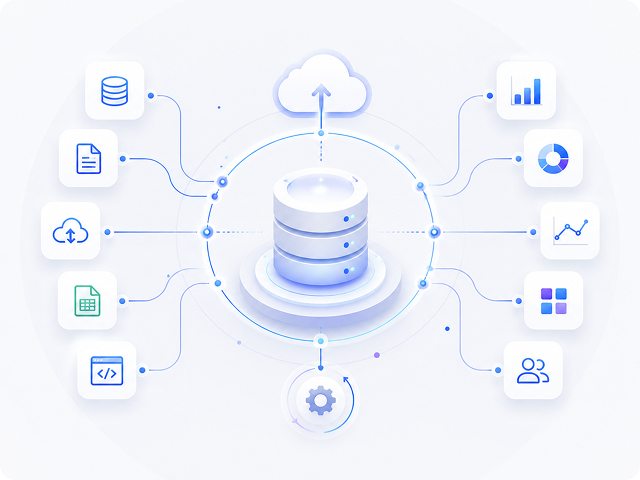









Data Warehouse or Data Lakehouse? An architecture that truly supports business growth
⏱️ Reading time: approx. 8–10 minutes
Most fast-growing companies eventually hit a wall where traditional spreadsheets are no longer enough. Imagine a board meeting where managers are trying to make a critical budget decision. Each of them pulls out “their” Excel spreadsheet and presents completely different numbers. Instead of a substantive discussion about strategy, the meeting turns into an argument over whose report contains the correct data.
Sound familiar? This is a classic result of data being scattered across dozens of ERP and CRM systems or marketing platforms. The solution to this chaos is a modern data platform. However, a fundamental question arises: Which architecture should you choose? A traditional data warehouse (DWH) or a modern data lakehouse? Which solution will truly drive your business’s growth?
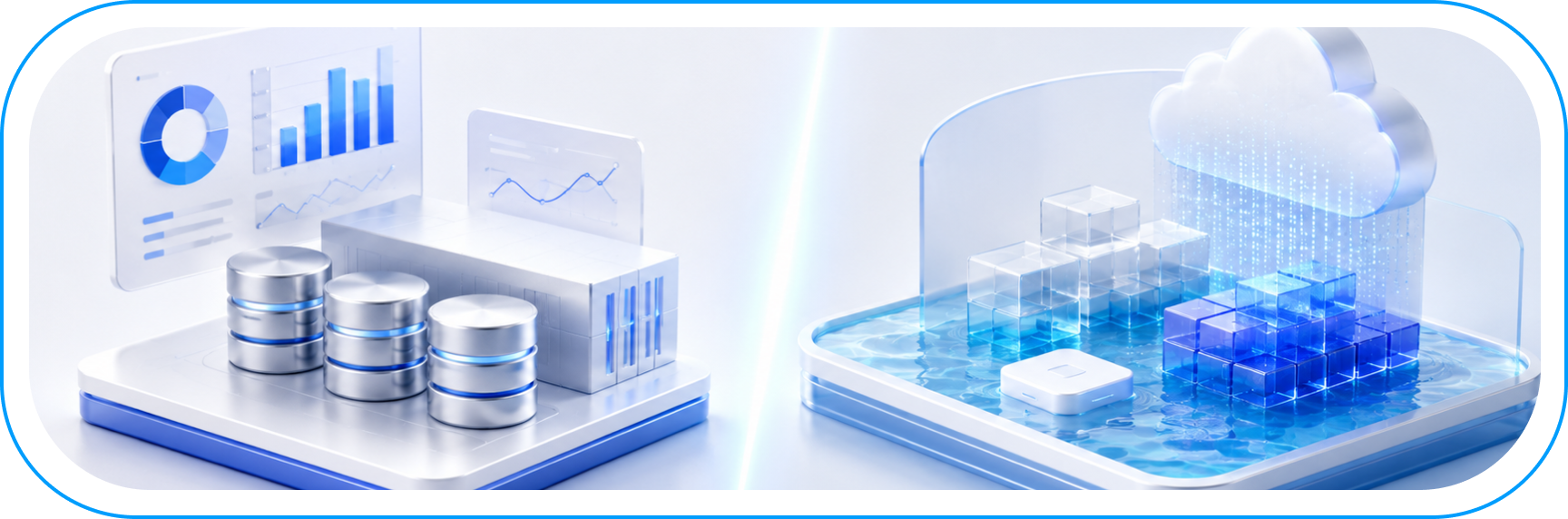
Modern Data Warehouse vs. Data Lakehouse - which should you choose?
For years, the standard in business was the traditional data warehouse, a centralized database designed for analyzing structured transactional data; today, modern data warehouses are more advanced digital data storage systems than classic databases, and older solutions increasingly require modernization to become more flexible. Such a modern warehouse as a digital system is not intended solely for simple storage because it handles both structured and unstructured data, supporting analytics and reporting across the entire organization. Meanwhile, Data Lakes are solutions where data lakes store structured, unstructured, and semi-structured data in various formats.
Today, a modern data warehouse is a more advanced digital data storage system than a classic database, and traditional systems are increasingly giving way to more flexible solutions. Today's technological revolution, driven by cloud computing and artificial intelligence (AI), has blurred these boundaries, giving rise to the concept of the Data Lakehouse. It combines the best features of both worlds: the flexibility and low cost of storing raw files (as in a data lake) with the full structure, SQL query speed, and uncompromising ACID transaction guarantees (atomicity, consistency, isolation, and durability). This makes it easier to work with various forms of information and organizes them into a cohesive ecosystem without any loss of operational flexibility.
For business leaders, the choice boils down to answering: what data do we need and how do we intend to consume it? If your company primarily relies on financial reports and tables from ERP systems, a modern, cloud-based data warehouse (e.g., Google BigQuery) will fully secure your needs and allow safe use of your data. However, if you plan to implement advanced predictive analytics, analyze customer behavior in real time, or feed AI models with unstructured data (e.g., PDF documents or logs), the natural direction is a Data Lakehouse, as it allows ingesting large volumes of data in real time without prior schema modeling.
Architectural design: How to build a secure and scalable foundation
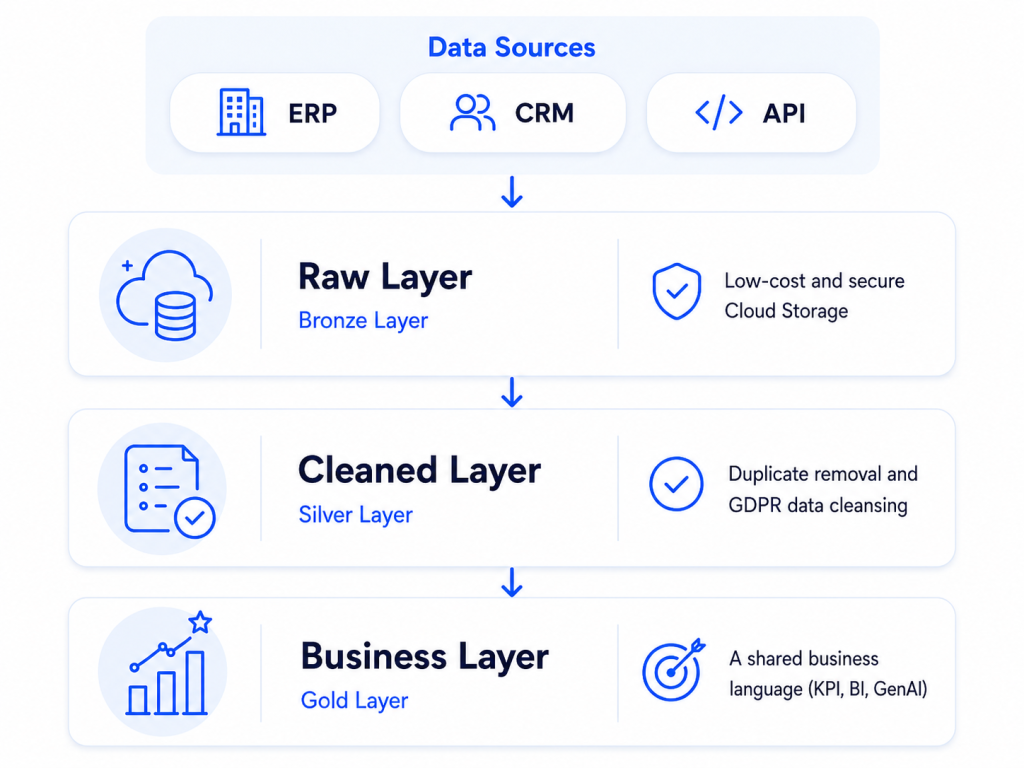
Regardless of the chosen model, effective data warehouse construction or a Lakehouse platform cannot be a chaotic technological process. Architecture must reflect business goals. Well-designed data architectures include lakehouse, warehouse, and other components needed for analytics. A key role is played by integrating data from multiple sources into a consistent view required for business analysis; well-designed integration also allows faster query processing and better data quality, essential for making accurate organizational decisions. In practice, data flows through ETL processes, including extraction, transformation, and loading into the warehouse. At Alterdata, we implement this through a structured architectural process where warehouse architecture organizes layers supporting analysis and business decisions, divided into clear layers:
1. Raw Layer (Bronze Layer / Ingestion)
Here, untouched data arrives directly from sources (POS systems, mobile app data, transactional databases), as well as from business applications and social media, with data coming from various channels, fitting well with big data scenarios. Storing them in inexpensive storage spaces (e.g., Cloud Storage) ensures we never lose historical context because this layer can store raw data in its original format, with the ability to accept data in various forms and processing stages and in large volumes.
2. Cleansed Layer (Silver Layer / Storage & Processing)
Raw chaos is transformed into an orderly set prepared to feed various analytical stores and other repositories. At this stage, data is unified, which is key for managing data quality and preparing for data analysis, ensuring the consistency required by the designed data warehouse, removing duplicates, errors, and sensitive information. Data from operational systems and other sources is standardized here before further use.
3. Business Layer (Gold Layer / Consumption)
This is the target data model ready for immediate use, prepared for reporting and data exploration by business users. It is the top layer of the architecture where the end user consumes data. Here, consistent, unique KPIs for the entire organization are defined, facilitating users to create reports independently without constant IT involvement. Data feeds BI dashboards (Looker, Tableau), reporting systems, and machine learning (ML) models that can use historical data to create reports and build forecasts suggesting optimal actions.
Important architectural lesson: Small, hasty technical decisions at the start of a project lead to huge future costs. Writing simple, “ad-hoc” scripts without thinking about scale causes a data pipeline that initially processes in 15 minutes to grow to 4 hours after a year, paralyzing the organization’s work. Therefore, from day one, we design solutions so that all data flows are ready for horizontal scaling. We build modular architecture allowing distribution of processing across many independent computing resources, enabling seamless and nearly unlimited performance growth as new data arrives. We also optimize structures by separating computing power from data storage and applying precise partitioning and clustering of tables. Thanks to this, the system grows smoothly with the business, and cloud costs remain under control.
Business benefits of implementing Data Lakehouse and modern DWH for Data Analysis
Why invest time and budget in advanced data foundations? Because well-executed data warehouse construction or Lakehouse platform enables extracting valuable business insights supporting decision-making, directly translating into measurable financial and operational gains that increase enterprise profitability:
- Elimination of information silos: All departments from finance through marketing to logistics start using one version of the truth, helping eliminate data silos and build a single source of truth for the entire organization.
- Shift from reactive analysis to future prediction: Traditional approaches rely on long batch processes analyzing dry historical data weekly or monthly, reacting to past facts. A modern platform enables stepping up to a higher data maturity level. It allows not only real-time analytics but primarily opens the door to advanced proactive analytics. Thanks to machine learning (ML) and artificial intelligence models, the organization gains the ability to create predictions, e.g., forecasting customer behavior, market trends, or process optimization in advance. For data-driven companies, these predictive scenarios are the ultimate point of building competitive advantage.
- Shortened Time-to-Value: A flexible and scalable cloud platform allows the business to deploy new reports and test hypotheses in just a few hours, not weeks. Importantly, this is with a properly designed system based on real organizational needs versus technology. A modern platform helps optimize IT budget and pay only for actually used resources (pay-as-you-go), instead of maintaining costly, underutilized infrastructure.
- Operational cost optimization: Better supply chain visibility or precise energy loss detection (as in our utilities sector implementations) bring immediate savings counted in millions of PLN.
The Role of Data Engineering and Automation Tools (Dataform, dbt)
Even the best architecture project won’t survive without rigorous engineering standards underneath. Performing data transformations directly in the database with uncoordinated queries is a quick path to repeating errors. A typical data warehouse relies on repeatable ETL processes and a clearly defined architecture.
Modern data engineering relies on tools like Dataform or dbt, which introduce software engineering standards directly into the analytics world and support collaboration needed by IT teams, analysts, and data engineers:
- Data lineage tracking: A visual dependency map allows tracing the full path of each field from the final report block back to the raw source file. Such visibility supports data management and better data flow governance throughout the platform. It builds invaluable business trust in presented numbers.
- Version control and change history: Every SQL code change undergoes peer review. We know exactly who, when, and why modified margin calculation logic.
- Automated tests and assertions: The platform verifies data quality before and after calculations. If critical tables contain nulls or amount anomalies, the system immediately alerts the team before erroneous data reaches management screens.
AI Readiness - Why data foundations determine AI success
Today every manager wants to implement AI systems, generative assistants, or autonomous AI agents in their organization. But the harsh truth is: there is no effective AI without organized data. In practice, lakehouse also supports data science and machine learning projects on one common data platform.
Deploying advanced chatbots (e.g., in RAG architecture) that analyze internal procedures or technical documents will fail if the same products are described inconsistently across various files. There is also the need to work with data from multiple sources and in different formats. AI fed with chaos will generate only chaotic hallucinations.
A properly built Data Lakehouse platform provides a secure, isolated space where the data lake is a flexible data storage layer, and the whole supports advanced model analytics. Language models (such as Google Gemini in Vertex AI) operate only on verified, validated business context. Your company data never leaves the organization, is not used for training public models, and AI agents return precise answers supported by specific quotes and source links. This approach gives teams the ability to safely use company data without copying it between systems.
Summary
The choice between a data warehouse and a Data Lakehouse structure should not be dictated by technological fashion but by the maturity and real operational needs of your company. A stable, modular architecture is an investment that frees the organization from tribal knowledge hidden in individual specialists’ heads and creates a foundation for safe AI innovations.
Do you want to transform scattered information chaos into one reliable source of truth for your company? Do you want to prepare your operational processes for advanced AI tool deployment?
Contact us and talk to an Alterdata architect – we will analyze your current system structure and jointly design a data platform tailored to your business growth dynamics.