








AI Implementation: How to build a foundation for modern analytics and GenAI on a Data Platform?
⏱️ Reading time: approx. 10-12 minutes
Many companies want to implement Generative AI "here and now," forgetting that artificial intelligence is only as good as the data it works with. Without a solid foundation, AI agents will generate hallucinations instead of valuable insights. So how to organize the process of building a data platform for AI to avoid getting stuck in endless testing phases?
Here is a proven roadmap that we apply in real projects with our clients. Successful AI implementation in a company involves gradually introducing AI-based solutions in various areas of activity, such as marketing, sales, or customer service.
Introduction to AI and Modern Analytics
Implementing AI in a company is a process that requires a well-defined AI strategy and the active involvement of business leaders to drive successful AI implementation. AI works best where there are repetitive tasks, large amounts of data, and the need for quick decision-making. In areas such as customer service, data analysis, or production process automation, using AI allows not only time savings but also making more accurate business decisions.
Modern AI tools enable companies to automate repetitive tasks, analyze large datasets in real time, and quickly respond to changing customer needs. By leveraging AI, organizations can gain a competitive edge in their industry, as AI becomes not only support for teams but also a growth engine for sales and competitive advantage. However, for AI implementation to bring the expected results, it is crucial to first define business goals and understand in which areas AI can realistically support the company’s operations.
Before starting AI implementation, it is worth analyzing where repetitive tasks that can be automated occur in your organization and where quick decision-making can translate into measurable benefits. Only on this basis can you select appropriate AI tools that will be real support in daily work and help achieve business objectives.

Business goals for building a Data Platform for AI
Building a data platform for AI is the foundation of effective artificial intelligence implementation in a company. The main goal of such a platform is to enable efficient data management and use it to make better business decisions. A well-designed data platform supports measurable business outcomes and enables organizations to launch effective AI initiatives that are aligned with strategic objectives. Thanks to a well-designed platform, the organization can not only increase work efficiency but also improve decision quality and accelerate sales growth.
AI implementation in a company should always be preceded by an analysis of real business needs and a clear definition of the goals to be achieved. Do you want to automate processes, improve data analysis, or increase the effectiveness of marketing activities? Selecting AI services that align with your business goals is crucial to ensure that your AI initiatives deliver maximum value. Answers to these questions will define how the data platform should look and what functionalities it should offer.
A data platform for AI in a company is not just a technological tool but primarily support in achieving business goals. It allows quick response to market changes, better understanding of customer needs, and more effective implementation of innovative AI solutions. Thanks to this, the organization can not only increase its competitiveness but also achieve tangible benefits such as sales growth or improved operational efficiency.
Step 1: Data Architecture for AI and the Medallion Model
Bringing order to chaos and analyzing data with Data Governance
First, you need to take control of the data stream. We do not throw everything into one bucket. We use the medallion architecture, which allows gradual cleaning and enriching of information:
- Bronze (Raw)
Here go raw data from CRM, ERP, logistics, or APIs in their original format. This is your digital archive that guarantees you never lose access to the original context of information.
- Silver (Trusted)
This is the heart of the process and your quality filter. Data here is cleaned, standardized, and deduplicated. At this stage, strong data governance practices are applied, with data stewards responsible for maintaining data quality and data integrity. High quality data is essential for AI implementation, as poor data quality can result in biased or inaccurate models. Data quality is judged on six dimensions: accuracy, completeness, consistency, timeliness, validity, and uniqueness. Analyzing data patterns at this stage helps ensure the data is reliable and representative for AI models. This stage is critical because AI fed with erroneous data will generate hallucinations (the Garbage In, Garbage Out principle). Here we eliminate errors before they reach language models.
- Gold (Curated)
The highest form of data, organized around specific business domains. Here we build One Big Table (OBT) structures - wide tables optimized for analytics and AI agents. Thanks to OBT, LLM models do not have to perform costly and slow table joins, which translates into lightning-fast responses and lower Google BigQuery maintenance costs.
Why is this approach crucial? As we often emphasize at our conferences, the biggest challenge in AI implementations is not the technology itself but cultural transformation. The medallion architecture ends the era when each department had its “own truth” in Excel. By creating the Gold layer, we give the company a common language and foundation that the business can fully trust. Only on such prepared ground can AI agents become real support in decision-making.

Step 2: Automating Data Engineering and Infrastructure
AI-Driven Engineering
Building a modern, “intelligent” data platform does not have to mean months of tedious programming work. At Alterdata, we reverse this process by using generative models to build environments for artificial intelligence. We shift the burden of repetitive work from engineers to algorithms, freeing up time to deliver real business value. Integrating AI tools directly into existing enterprise systems is crucial for maximizing effectiveness and ensuring seamless automation across business processes.
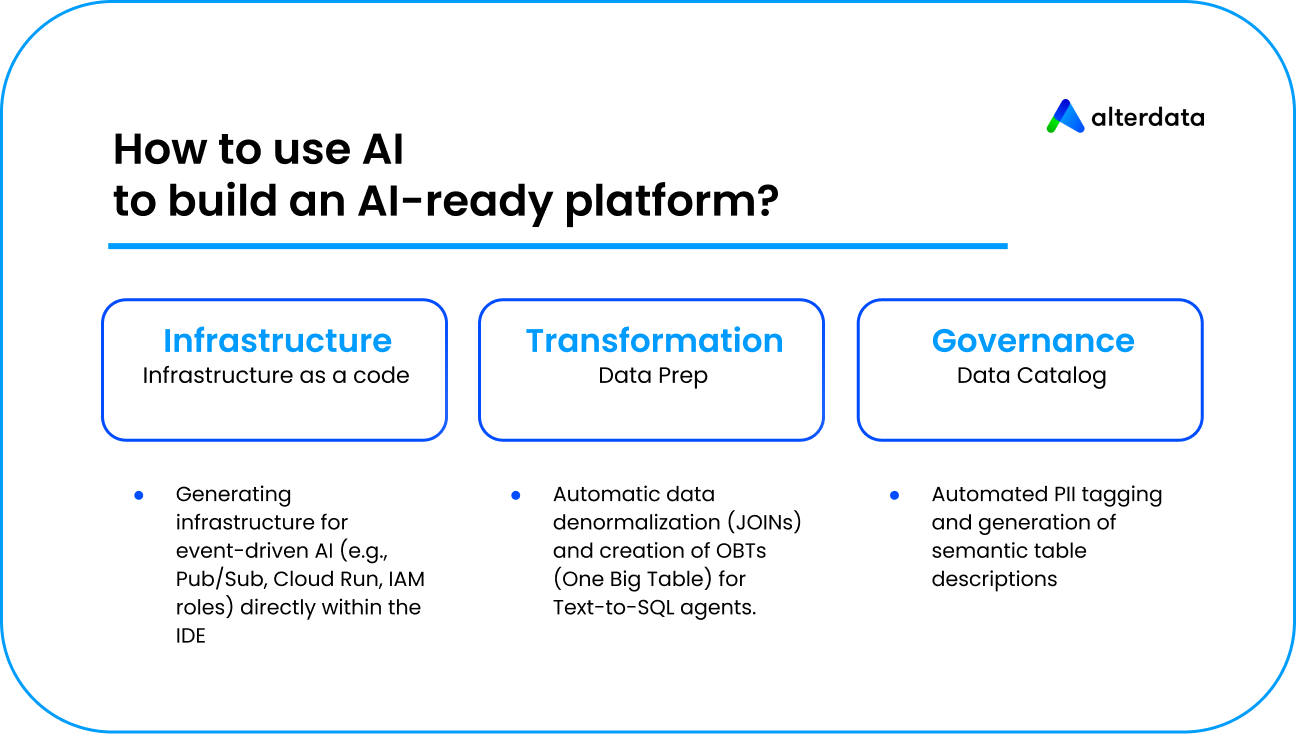
Our approach is based on three key automation pillars:
- Infrastructure (Infrastructure as Code): Manual configuration of cloud environments for AI systems is often the biggest bottleneck in projects. We use AI assistants (so-called AI Co-pilots in IDE environments) to instantly generate infrastructure code for event-driven architectures. Templates for services like Pub/Sub, Cloud Run, or strict IAM roles are created in minutes, and the engineer shifts from code creator to architecture reviewer. Deployment time shortens from weeks to days. In addition, we implement access controls and prioritize regulatory compliance to safeguard sensitive data and manage risk in cloud environments, reducing the likelihood of security breaches.
- Transformation (Data Prep): Here we combine high performance with drastic cost optimization. Language models (LLMs) struggle with many joined tables. Therefore, AI helps us automatically denormalize complex data (e.g., from ERP systems) into flat One Big Table (OBT) structures. Thanks to this, analytical agents (Text-to-SQL) respond faster, do not hallucinate, and query costs in warehouses like Google BigQuery drop by up to 60%. We leverage advanced AI algorithms, machine learning, and AI capabilities to process and transform data efficiently. Continuous improvement and continuous monitoring are essential to maintain model performance, accuracy, and reliability over time.
- Governance (Cataloging): For artificial intelligence to work correctly, it needs perfect business context. Unfortunately, manual documentation for thousands of columns is a process every IT team avoids. At Alterdata, we fully automate this. We use generative model APIs to automatically profile new data: the system creates semantic descriptions of tables and tags sensitive data (PII) in a data dictionary (Data Catalog). Documentation creates itself and always keeps up with the code. Governed data and AI-powered data catalogs ensure data is managed, accessible, and compliant, while robust controls help prevent security breaches.
Automation of responses and process automation using AI systems allows companies to react faster to changes in the business environment, better tailor communication to audience needs, and increase operational efficiency. AI supports marketing by automating processes, enabling faster reaction to search engine algorithm changes and more effective communication activities. However, it is crucial to implement automation only after prior improvement of operational processes, treating it as the final stage of digital transformation. Instead of constantly deploying new tools, it is worth focusing on optimizing and fully utilizing existing AI systems, which translates into lower costs and less environmental impact.
Why does this matter? Thanks to this approach, we remove “technical debt” at the start of the project. Our clients receive a platform that not only works but is perfectly documented, secure, and easy to scale. This is the moment when technology stops being a blocker and starts truly anticipating business needs.
When implementing AI, it is also necessary to take care of employee development and educate leaders and teams – investing in training and developing digital competencies increases team efficiency and skills. Employees do not have to be AI experts but should understand how to use tools and interpret their results, which can be achieved through short training sessions. Security and responsibility should be an integral part of AI implementation - this includes both technical and organizational issues such as procedures, team training, and clear rules for using AI tools.
Step 3: Semantic Layer and Conversational Analytics
One language for the entire company
When data is already organized in the medallion architecture and automated thanks to AI, we must give it business meaning. The semantic layer is a key element of a modern platform that acts as a “translator.” Here we define the logic according to which AI agents and all analytics in the company work. Without this stage, artificial intelligence sees only technical column names (e.g., f_01_id), which makes any intuitive work impossible. AI supports data analysis and business decision-making by providing data-based insights and recommendations that help optimize activities and increase business value. Natural language processing enables intuitive interactions with AI, allowing users to communicate with systems using everyday language, which is essential for conversational analytics, chatbots, and voice assistants. Data scientists play a crucial role in developing and maintaining these AI solutions, ensuring that models are accurate and effective. AI projects in this area drive innovation and business value by leveraging advanced analytics and fostering a culture of data-driven decision-making. Generative AI can deliver a 44% increase in human productivity across various business functions, showcasing its impact on workforce efficiency. AI models used in this process require continuous testing and adaptation to ensure effectiveness and real business value for the company.
Why is this step the foundation of trust in AI?
- One definition of truth: In the semantic layer, we definitively establish what an “active customer” or “net margin” is. Thanks to this, when the sales director and finance director ask AI for results, they always receive consistent answers based on the same methodology.
- Required context (Metadata and Golden Queries): AI Agent does not guess - it requires precise data descriptions and context. We use so-called Golden Queries, exemplary queries that teach the model how to correctly interpret company-specific metrics.
- Full isolation and Read-Only mode: This is one of the most important security aspects. Our AI Agent operates only in read-only mode and is completely isolated – it has no access to the public internet. It analyzes your data but cannot change it or transfer it outside the company’s secure environment.
- Democratization and end of “SQL queues”: The semantic layer separates complicated technology from business. Non-technical people can ask questions in natural language and get answers in seconds. This ends the era of waiting weeks for a simple report from the analytics department. We also support the Human-in-the-Loop approach, where people are involved in the AI decision process, especially in high-risk tasks, increasing security and control over business decisions.
- Cost transparency in BigQuery: When implementing conversational analytics, we care about the client’s budget. Managing agent costs does not differ from standard best practices – we set strict limits in Google BigQuery (BQ), ensuring full control and predictability of infrastructure expenses.
- Predictive analytics: Thanks to AI, predictive analytics is possible, allowing trend forecasting based on historical data and faster reaction to market changes. AI supports decision-making in companies by combining data from various sources and presenting it in a readable form, facilitating analysis of action results and better understanding of customer needs.
Result? Data consistency ceases to be just a slogan and becomes a fact. Thanks to the semantic layer, your data platform for AI not only stores information but can tell about it in a human voice, maintaining the highest standards of security and cost control.
Step 4: Security and Orchestration of AI Systems (Model Armor)
In the final step, we connect all layers into one intelligent ecosystem. Having ready foundations (Medallion) and defined logic (Semantic Layer), we can launch AI process orchestration. This is where data turns into action - e.g., automatic response to a complaint or shipment status analysis. Gen AI supports secure and efficient orchestration of these AI processes, enabling enterprises to scale automation while maintaining compliance and operational control.
The key to success at this stage is the combination of three elements visible in the diagram above:
- Query protection (Vertex AI Model Armor): Democratizing data access carries risks. AI implementation must be responsible and compliant with regulations such as GDPR and AI Act. When we allow users free interaction with AI assistants (e.g., Text-to-SQL in BigQuery), every entered prompt passes through the Model Armor layer. This is our “digital firewall for AI,” which scans query intents in real time. It protects the model from Prompt Injection attacks (attempts to bypass assistant logic) and guarantees that confidential database information will not leak into logs or unauthorized conversations. Companies should deploy closed, corporate AI model instances to prevent data leaks.
- Built-in Intelligence and Data Isolation (Row-Level Security): Modern analytics does not require building complicated external applications. At Alterdata, we use managed assistants (such as built-in Gemini in BigQuery) that natively interpret business context defined in Dataplex. Crucially, artificial intelligence never has full warehouse rights. When generated SQL code is executed, the database engine applies Row-Level and Column-Level Security (RLS/CLS) filters. Thanks to this, even if AI generated a query covering the whole world, a sales director from the western region will receive only data they have permissions for in the identity system (IAM). We have 100% certainty that AI will not breach access rights.
- Human in the Analytical Process (Human-in-the-loop): Full trust in AI assistants requires transparency. In our approach, artificial intelligence performs heavy analytical work: it searches structures, joins tables, and generates cost-optimized SQL code. However, before the query is executed in the database, the system always presents it to the user on an interactive canvas (e.g., in Data Canvas). An analyst or manager can verify assumptions, correct criteria, or simply approve the analysis with one click. AI implementation carries the risk of generating incorrect recommendations, which can lead to inappropriate business decisions. Therefore, every organization should clearly define who is responsible for decisions made based on AI-provided data – appointing a specific person responsible for AI implementation is key in every organization, regardless of its size or industry.
Security and responsibility should be an integral part of AI implementation in every organization - this includes both technical issues (data protection, model isolation) and organizational ones such as procedures, team training, and clear rules for using AI tools.
Final effect? Your data platform for AI ceases to be just a “knowledge warehouse” and becomes an autonomous operational engine. Thanks to this, you free your experts’ time, reduce human errors, and shorten reaction time to business events to milliseconds.

Practical Applications of a Data Platform for AI
A data platform for AI opens wide possibilities for practical use of artificial intelligence in daily operations. In online marketing, AI supports automation of advertising campaigns, communication personalization, and effectiveness analysis of social media activities. Thanks to response automation, companies can handle customer inquiries faster and more effectively, using chatbots and process automation tools. AI-driven personalization and insights enable businesses to create hyper-personalized experiences that foster stronger customer loyalty and repeat business.
In practice, a data platform for AI also enables lead potential assessment, identification of areas where the company loses the most time and money, and automation of repetitive business processes. For example, data analysis allows quick detection of sales trends, production process optimization, or better management of marketing campaigns.
AI implementation in a company translates into real benefits: increased team work efficiency, improved business decision quality, and sales growth. Thanks to a data platform for AI, the organization can not only streamline existing processes but also discover new development and innovation opportunities that were previously out of reach due to time or resource constraints.
Common implementation mistakes for successful AI Implementation and how to avoid them
AI implementation in a company is a process that requires not only appropriate tools but above all a strategic approach and clear definition of business goals. One of the most common mistakes is the lack of precise definition of what business goals the AI implementation should achieve. Without this, disappointment with results and inefficient resource use are easy.
Another problem is inappropriate choice of AI tools – companies often choose solutions that do not match their real needs or do not integrate with existing data infrastructure. Equally important mistake is skipping business needs analysis and lack of thoughtful data management, which leads to information chaos and hinders effective AI implementation in the company.
To avoid these pitfalls, it is worth starting with a thorough analysis of the organization’s needs, defining business goals, and selecting AI tools that truly support these goals. Designing a data platform should consider easy data management, security, and scalability as the company grows. A unified data architecture is crucial to avoid data duplication, improve cost controls, and ensure the platform can scale efficiently. AI implementation is not a one-time project but an orderly process that requires strategic approach and continuous adaptation to changing business needs.
Summary: Data Platform for AI as a Process
Building a data platform for AI is not a one-time project but an evolution: from organizing (Medallion), through automation (Infrastructure/Transformation), to understanding (Semantic Layer) and security (Model Armor). Only such arrangement of building blocks allows full scalability and real gains from GenAI.
Want to go through this path with an experienced partner? We will help you build foundations that will withstand the pace of the AI revolution.👉 Consult your data strategy with Alterdata