








⏱️ Reading time: approx. 10 minutes
Introduction
In the modern business landscape, data is widely referred to as the "new fuel." However, the reality for many organizations is that this fuel remains locked in massive, inaccessible silos. Despite collecting terabytes of information, the ability to use it for daily decision-making is often a privilege reserved for a small group of specialists.
The traditional analytical model has become a bottleneck. Today, every business decision requires a report, every report requires a complex SQL query, and every query ends up at the back of a long queue in the IT or Data Engineering department. Consequently, by the time a manager receives an answer, the market context has shifted, and the business opportunity has vanished.
Data democratization, fueled by the GenAI revolution, is the process that finally breaks down these barriers. It transitions organizations from the stage of tedious information preparation to an era of real-time knowledge utilization. Thanks to Generative AI, companies can finally stop "managing reports" and start truly managing the value derived from their data.
Why has traditional Data Democratization failed until now?
Over the past decade, organizations have funneled massive budgets into modern data warehouses and advanced Business Intelligence (BI) tools. Theoretically, data became available. In practice, however, its operational utility remained low. Even the best dashboards are not always intuitive, and the lack of a “common language” between business and technology has proven to be an insurmountable barrier.
Business users still face three primary obstacles:
- Requirement for Technical Expertise: To extract custom insights, one previously needed to understand table structures or navigate complex filters. This cut off decision-makers—who are not programmers—from vital knowledge.
- Consumption vs. Exploration Model: Traditional reports are static. They answer the questions asked at the time of their design but do not allow for a free dialogue with data when new, dynamic problems arise.
- Low Data Literacy: Without proper training, employees often fear misinterpreting results. This creates mental silos: “My Excel is better than your dashboard,” leading to a lack of trust in the data.
Traditional models require frequent data requests to IT, which causes delays and creates bottlenecks, especially when access is restricted for compliance and security reasons.
Ultimately, democratization remained just a buzzword—data was “available” in the system but “inaccessible” to the minds of decision-makers. Every non-standard business question generated a Jira ticket and days of waiting for an analyst’s availability.
Data democratization ensures that authorized users can securely interpret and act on information without always depending on IT to retrieve it.
The GenAI Breakthrough: Natural language as the new analytical interface
The emergence of Large Language Models (LLMs) and Generative AI is shifting the paradigm of how we work with information. These advanced systems enable not just analysis, but more importantly, the interpretation of data in a way that is understandable to everyone. Until now, the biggest barrier to accessing knowledge was language business speaks the language of outcomes, while databases speak SQL.
Conversational analytics acts as an intelligent translator. Thanks to Natural Language Processing (NLP) and Machine Learning, human language becomes the interface for complex databases. What does this mean in practice for your company?
- Removing the Barrier to Entry: Every manager from marketing to logistics can "ask" the system for data using simple prompts, without any knowledge of coding.
- Scaling Analytics: The number of people actively working with data grows exponentially without burdening the engineering team, who can then focus on architecture rather than "fixing spreadsheets."
- Exploration over Reporting: Analysis becomes an iterative process. You can ask a question, receive a result, and then immediately dive deeper by asking for details that have just caught your attention.

From reactive reporting to active data dialogue
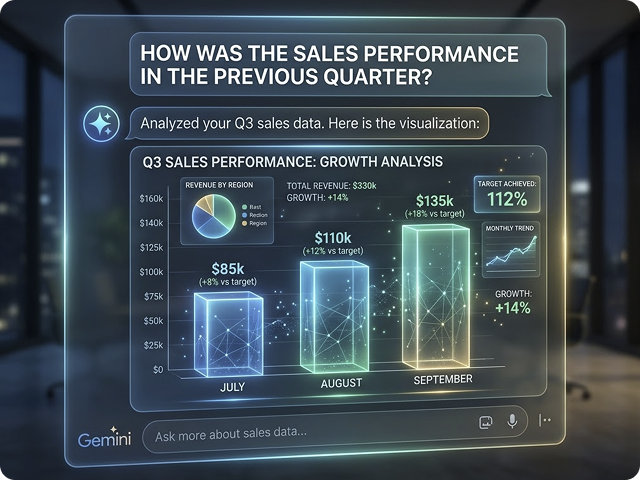
Traditional reporting is reactive—it is like looking in the rearview mirror. Data democratization supported by AI enables a proactive approach. Instead of waiting for a pre-packaged report, you enter into a direct dialogue with your data:
- User Question:“Which customer segments drove the most revenue growth in the last 3 months?”
- AI Response: The system generates a trend chart and identifies specific groups.
- Deep Dive:“And what factors—price, region, or product category—had the biggest impact?”
- AI Insight:“The growth is primarily driven by the Mid-Market segment in the EMEA region following a reduction in logistics costs within the Electronics category.”
Conversational analytics powered by GenAI enables users to gain insights from customer conversations, helping improve customer experience and drive more informed business decisions. By analyzing these interactions, businesses can extract valuable customer insights—such as preferences, sentiments, and emerging issues—which can be used to personalize responses and enhance service quality. Advanced NLP techniques and detailed report analysis help identify trends, monitor agent performance, and optimize business decisions by providing actionable intelligence from speech and chat data.
With GenAI, users can go beyond data analysis; they can leverage tools to create new content, generate images or videos, and predict future outcomes based on existing data. The applications of AI are vast—from optimizing logistics processes and personalizing e-commerce offers to automating financial reporting or generating creative media content. It is fair to say that competitive advantage today stems largely from the effective use of AI to make data-driven decisions.
This workflow reduces the so-called time-to-insight from days to seconds. This allows for real-time offer personalization, instant marketing budget optimization, and taking action based on AI-driven predictions.
The era of true information utilization
Until now, a vast amount of organizational energy was spent on:
- Creating reports,
- Manually merging various data sources,
- Verifying the accuracy of figures,
- Preparing presentations.
This was the era of information preparation.
Thanks to GenAI (Generative Artificial Intelligence), we are entering a new stage where:
- Questions can be asked in real-time,
- Analyses are iterative and exploratory,
- Business teams can independently test hypotheses using advanced models based on machine learning.
This is the era of true information utilization.
The difference is fundamental:
information stops being a static end-product and becomes an interactive work tool. By leveraging AI and modern applications, it allows for data-driven decision-making in real-time.
Data democratization provides employees with high-quality, well-governed data and intuitive tools, enabling them to independently explore and analyze datasets to generate data driven insights. This approach ensures the right people have access to the right data at the right time, making it easier for end users to find trusted data insights.
Technological Foundations: Google Cloud and the Single Source of Truth
The foundation remains critical. It is essential to state clearly: LLMs do not replace data architecture. For conversational analytics to be reliable and secure, the following are required:
- A Single Source of Truth (SSoT),
- Consistent KPI definitions,
- Organized data models,
- Access control and governance,
- Quality monitoring.
Enterprise data must be centrally governed, secured, and accessible across business units, fostering collaboration and maintaining integrity and security. GenAI accelerates data utilization, but it cannot fix architectural chaos. Therefore, democratization in the era of LLMs is a synergy of solid foundations and an intelligent conversational layer.
The scale of change is the most significant difference. In the classic model, access to advanced analytics was limited to a dozen or so people in an organization. In a conversational model, access can be granted to every manager, team leader, or operational specialist. This:
- Shortens the distance between a question and a decision,
- Increases the pace of experimentation,
- Lowers the cost of analysis,
- Strengthens the culture of data accountability.
Data democratization fosters collaboration across teams, drives innovation, and accelerates time to insight while maintaining the integrity and security of enterprise data.
Democratization ceases to be a buzzword it becomes a daily operational practice.
Our key elements of the modern data platform at Alterdata:
- Cloud Source Integration: Solutions such as Google Cloud BigQuery allow for the scalable and secure integration of massive datasets.
- Data Governance and Security: Democratization does not mean a lack of control. Robust mechanisms like Role-Based Access Control (RBAC) and Data Quality management are essential to avoid “garbage in, garbage out.” Strong data governance is required to ensure compliance and protect sensitive information.
- Employee Training and Data Literacy: Effective data democratization strategies include providing training and tools to improve data literacy among employees, enabling self service analytics so non-technical users can independently access, analyze, and visualize data.
Generative AI-powered Services: Services such as content generation, AI chatbots, and process automation are made possible by models based on various AI technologies. Successful implementation requires not only the right infrastructure but also employee training, high-quality training data to improve AI model performance, and research into data quality and interpretation. Enhanced training data supports advanced data science initiatives and fosters collaboration across teams.
Best practices for sustainable Data Democratization
Achieving sustainable data democratization requires a thoughtful approach and adherence to best practices. Begin with a clear data strategy that aligns with your business goals and ensures that data assets are accessible, secure, and well-governed. Implement role-based access control to provide the right data to the right people, maintaining security and compliance without sacrificing agility.
Ongoing training and support are essential for building data literacy and fostering a data-driven culture. Encourage data sharing and collaboration across teams to maximize the value of your data. Prioritize data quality at every stage, ensuring that insights are reliable and actionable.
Leverage advanced technologies such as natural language processing, machine learning, and artificial intelligence to analyze customer interactions and gain actionable insights. By embedding these practices into your organization, you can create a scalable, resilient data democratization program that drives innovation and long-term business success.
What are the implementation challenges?
Implementing artificial intelligence within an organization is a process that carries immense potential alongside very specific challenges. One of the most critical aspects is data preparation data must not only be complete and of high quality but also properly organized so that AI models can generate reliable results. This stage often requires significant time and the involvement of specialists, which can be a barrier for many companies.
Another challenge is the shift in organizational culture. Introducing AI-driven solutions requires an openness to new workflows, a readiness to learn, and trust in the recommendations generated by algorithms. Regarding data democratization, it is essential that employees at all levels understand how to use these new tools and how to correctly interpret analytical results.
Despite these difficulties, the benefits of implementing AI are hard to overstate. Generative Artificial Intelligence allows not only for the analysis of existing information but also for the generation of new data, opening entirely new possibilities in fields such as marketing, sales, and customer service. This enables companies to test new strategies faster, personalize offers, and respond effectively to market needs. AI is becoming more than just an analytical tool; it is an engine of innovation that allows organizations to stay ahead of the competition and build a lasting business advantage.

Business benefits and competitive advantage
Companies that effectively implement a data democratization model gain a measurable edge over their competitors:
- Faster Decision-Making: Shortening the distance between a business question and an answer allows companies to outpace the competition in reacting to market trends. The implementation of GenAI significantly boosts the efficiency of decision-making processes, leading to faster and better business outcomes. Generative AI automates repetitive tasks, freeing up professionals to focus on more strategic work.
- Increased Innovation: When operational specialists have seamless access to data, they more frequently discover new market opportunities and optimizations that IT analysts might overlook. For example, in a marketing campaign, marketing managers can independently access performance data in real time, enabling more agile and data-driven marketing decisions without waiting for IT support. AI is often perceived by users as a creative partner that supports the generation of innovative solutions, though it also prompts important discussions regarding authenticity and originality.
- IT Cost Optimization: Data engineers are relieved from repetitive, low-level queries, allowing them to focus on high-value tasks such as building advanced predictive models and machine learning workflows. Data democratization reduces the workload on specialized personnel, such as data experts, by enabling a broader range of users to access and interpret data independently. AI-powered services including content generation, chatbots, and automated data analysis - support daily business operations and are easily accessible via cloud-based platforms.
- Enhanced Customer Experience: With instantaneous insights into customer behavior, marketing and support teams can deliver more personalized and relevant solutions. However, success depends on investing in employee education to fully leverage GenAI tools while ensuring a responsible and ethical deployment of AI across the organization.
Summary: Your company in the era of knowledge
What does full data democratization truly mean in the GenAI era? It is more than just access; it is the ability for every employee regardless of department or technical skill - to process, analyze, and act on data. GenAI finds applications across a vast range of industries: from automating business processes and content creation to education, entertainment, and heavy industry. This shift allows companies to react faster to new data, generate reports in real-time, and make decisions based on the most current results.
In the age of GenAI, data democratization is no longer a technological curiosity it has become the foundation of modern management. Moving from static SQL reports to dynamic, conversational workflows is the only way to fully unlock the potential hidden within your information.
At Alterdata, we do more than just deliver technology - we help build a data-driven culture. From auditing your current architecture and building scalable cloud data warehouses to the secure implementation of an AI layer, we enable your team to "talk" to data as if they were consulting with a top expert.
The era of waiting for reports is ending. It is time to start using information in real-time.
Want to see how conversational analytics can transform your business? Contact us today for a free consultation. Together, we will build the foundations of your competitive advantage.