







⏱️ Reading time: approx. 15 minutes
Introduction
Until recently, creating IT systems in organizations involved making difficult choices. Companies faced a dilemma: fast deployment but limited customization to business specifics, full customization but at the cost of long delivery times and high expenses, or enterprise-level stability and security, which often meant a lack of flexibility. Each of these solutions had its advantages, but there was no way to combine all these aspects into one approach.
Traditional methods generated high costs, faced technical limitations, and potential risks, especially when trying to meet specific business needs.
Today, this situation is changing. The development of artificial intelligence and modern engineering practices is revolutionizing software creation. AI development opens up the possibility for organizations to combine the speed typical of SaaS, the flexibility of custom software, and the high standards of quality and security of the enterprise class. This approach is becoming the new standard, allowing companies to deliver solutions perfectly tailored to their needs faster, without compromising on quality.
Reports from 2025 show:
✔️ Over 80% of developers using AI report increased productivity.
✔️ AI is used daily by about 90% of programmers.
✔️ AI improves code quality according to 59% of respondents in the DORA 2025 study.
Traditional limitations vs. the new reality of AI Development
For many years, organizations had to choose between three software development models. SaaS offered a quick start and low costs but limited personalization options and no full control over the system. Custom software provided full alignment with business needs but involved long delivery times and high costs. Enterprise-class solutions guaranteed stability and security but often at the expense of flexibility and speed of adaptation.
Currently, thanks to AI development, it is possible to break these barriers. Companies can execute projects at a pace close to SaaS while creating solutions strictly tailored to their processes and compliant with the highest enterprise standards. AI integration enhances custom software applications, allowing them to scale and adapt to evolving business needs. AI development provides greater control over the system and data and enables effective AI deployment management. AI implementations often require proper organizational preparation, minimizing potential problems and ensuring process consistency. The key is using artificial intelligence to automate repetitive tasks, accelerate processes, and integrate with existing infrastructure and systems. AI automates repetitive processes such as data entry, reporting, and scheduling, boosting overall productivity. Thanks to AI, productivity increases and improved efficiency is achieved by streamlining workflows and optimizing resources. AI can process vast amounts of data quickly and accurately, enabling better and faster decision making for businesses. As a result, risk management improves, and employees can focus on more complex and valuable tasks.
How does AI Development accelerate software creation?
In practice, AI development means teams use ready-made foundations such as cloud computing, data platforms, and security, while automating many software engineering stages. This allows for rapid iteration of solutions based on real data, shortening the time from idea to delivering business value from months to weeks. Additionally, AI enables process optimization, increasing team productivity and better utilization of AI tools, applications, and platforms for automation and software lifecycle management. Thanks to AI-Driven Development, organizations can create innovative solutions, utilize continuous monitoring and optimization, and maintain consistency while implementing advanced features faster than ever before. Collaborative work on AI deployments achieves real business value, eliminates major challenges, and minimizes technical limitations and potential risks. Thanks to AI, companies can respond faster to market changes and compete more effectively.
Artificial intelligence supports automation of code generation, testing, documentation, and real-time system monitoring. AI also enables automatic verification of AI agents' operation, monitoring model behavior, and identifying potential issues and risks in code. Test automation and monitoring impact software quality, allowing earlier defect detection and improved security. AI tools can reduce time spent on repetitive coding tasks, and AI-Driven Development leads to fewer post-deployment defects and more innovative product features. AI automatically generates test cases, predicts problem areas, optimizes test coverage, and supports automatic code documentation, including generating comments, API descriptions, and usage examples. AI can also analyze business requirements, identify and prioritize them, generate UML, use cases, and test scenarios, and support code migration between programming languages. AI tools and platforms enable continuous application monitoring, anomaly detection, and automation of routine tasks, allowing developers to focus on more creative work. AI also improves user experiences through personalized recommendations and interaction automation by analyzing user behavior and adapting applications to their needs. All this translates into higher quality, greater productivity, better optimization, and real business value.
Tools and technologies in AI Development
Modern business growth increasingly relies on advanced AI solutions that allow companies not only to keep up with market changes but also to set new efficiency standards. We focus on technologies that genuinely support automation of repetitive tasks, process optimization, and making informed data-driven decisions.
Our approach is based on implementing solutions utilizing machine learning, natural language processing, and employing AI agents and advanced language models. Thanks to these technologies, it is possible not only to analyze vast data volumes but also to understand context, generate recommendations, and automatically process documents and queries in natural language. These tools enable rapid automation deployment, which translates into increased productivity and better resource utilization within organizations.
In practice, AI solution implementation optimizes key business processes from automatic report generation, through intelligent recommendation systems in e-commerce, to decision support based on data analysis from various sources. This allows companies to focus on development and innovation, leaving repetitive tasks to intelligent tools.
If you want to learn how AI technologies can support your organization's growth, we are happy to analyze your needs and propose solutions perfectly tailored to your business specifics. Contact us to jointly plan the implementation of modern AI tools and gain an advantage through automation and process optimization.
Why is it still custom software?
Despite speed and automation, solutions created in the AI development model remain fully tailored to a specific organization's specifics. Already at the analysis stage, we identify specific business needs and manage requirements, allowing precise solution customization. Business logic is designed to reflect real processes, and data models and integrations are adapted to the existing IT ecosystem. In AI solution design, control, consideration of technical constraints, and consistency of final results are key. AI operates in the company context, not a universal client, avoiding vendor lock-in risk and providing full control over data and decisions. Team involvement at every implementation stage ensures high quality and effective execution.
Thanks to this, organizations can develop their systems alongside business growth, combining SaaS-like AI deployment speed with the flexibility and quality of custom software. AI supports legacy system refactoring and modernization, helping solve major challenges such as costs, risks, or lack of documentation faced by companies with similar problems. Business requirement analysis automation and automatic code review improve compliance with legal and industry standards. Creating and managing AI-based applications and products translates into real business value, enabling effective AI deployments and measurable benefits.
Enterprise-class quality as a foundation, not an addition
Delivery speed cannot come at the expense of quality and security. In corporate environments, instability, unstable integrations, or insufficient auditability can lead to serious business risks. Control, monitoring, and AI deployment process management ensuring high quality, security, compliance, and adherence to operational standards are crucial. A centralized registry of AI models supports scalable deployment while maintaining security and adherence to operational standards. Responsible AI governance is essential for ensuring that AI systems deliver business impact without veering off course. Centralized governance mechanisms regulate data access and support risk management in AI projects.
Therefore, AI development at the enterprise level requires an approach that assumes production-grade quality from day one. This includes designing solutions compliant with corporate architecture, implementing DevOps and DevSecOps practices focusing on quality, productivity, optimization, managing technical constraints, consistency, continuous improvement, and driven development. In practice, this also means identifying potential risks and issues at every AI deployment stage, allowing early detection and elimination.
It is worth emphasizing that AI-Driven Development can reduce post-deployment defects. Artificial intelligence automatically generates test cases, predicts potential problems, optimizes test coverage, and improves compliance with legal and industry regulations through automatic code review. AI also enables advanced real-time application monitoring, detecting anomalies before they escalate into serious incidents. This improves overall software quality by early problem detection and better team collaboration.
Only such an approach guarantees that fast deployments will be durable and secure.
The Role of a technology partner
A key success factor is cooperation with an experienced partner who not only delivers AI solutions but also supports the organization in architecture design, integration with existing systems, and provides automation and monitoring. Partner team involvement in the implementation process translates into effective goal achievement and high-quality work. Many organizations are increasingly adopting open-source AI solutions to enhance scalability, reduce costs, and improve transparency, reflecting a broad industry shift towards open-source platforms.
Such a partner plays a crucial role in managing, controlling, and monitoring AI deployments, using modern platforms and AI tools that support driven development and process optimization. Many firms use an "AI Studio" or Center of Excellence to centralize reusable tech components and talent, streamlining AI development and deployment. Thanks to experience in various technologies, the partner can identify potential risks, solve major challenges related to legacy system modernization, and support organizations facing similar problems during AI implementation. Offering a comprehensive support program, the partner focuses on generating real business value and ensuring effective solution adoption. A strong culture that embraces experimentation, adaptation, and a data-driven mindset fosters successful AI use.
It is worth emphasizing that proper organizational preparation minimizes the risk of ineffective AI implementation, and companies actively addressing AI implementation concerns achieve three times higher tool adoption rates.
Practical approach to AI Development
In practice, this process looks as follows:
Quick start on solid foundations – initial application versions are created quickly using AI platforms that enable automatic code generation and business requirement analysis automation (utilization). Thanks to AI tools, it is possible to create high-quality documentation, generate UML, use cases, and test scenarios, significantly increasing team productivity. AI-Driven Development allows automating code generation, a breakthrough comparable to the advent of IDEs or version control systems. This enables organizations to achieve real value early in AI deployments and faster identification of potential problems and technical constraints.
AI as a delivery accelerator – AI tools automate data processing, accelerate model and application creation, testing, and verification, enabling continuous optimization and rapid iterations. AI can automatically generate test cases, predict potential problems, and optimize test coverage, leading to reduced time spent on repetitive coding tasks and fewer post-deployment defects. AI supports real-time monitoring of model and application behavior, detecting anomalies before they become serious incidents. Thanks to advanced features, AI enables automatic risk identification and supports AI deployment process optimization.
Custom enterprise-class logic and integrations – AI operates behind the scenes, integrating with platforms, ERP, CRM, data warehouses, and other applications, respecting roles, permissions, and responsibilities within the organization. AI tools support driven development, automating code migration between programming languages while preserving design patterns and business logic. AI enables automatic identification and prioritization of requirements based on business value, complexity, and urgency, and generates recommendations for users, personalizing experiences and automating interactions. Thanks to this, organizations can together effectively measure and improve integration processes, minimizing potential risks and major challenges related to legacy systems.
Production-grade quality from day one – deployment automation, model and data versioning, continuous quality, consistency, and stability monitoring, and AI decision auditability ensure enterprise-class standards. AI tools enable automatic code documentation, generating high-quality comments, API descriptions, and usage examples, improving quality and security. Verification of AI agents' operation and application behavior monitoring allow early detection of potential problems and test cost optimization. AI supports optimization and automation of routine tasks, allowing teams to focus on creating innovative features and enhancing user experiences through personalized recommendations. Thanks to AI, organizations can scale technological operations without proportional human resource growth, achieving real business value from day one of deployment.
Why is AI Development the future of software creation?
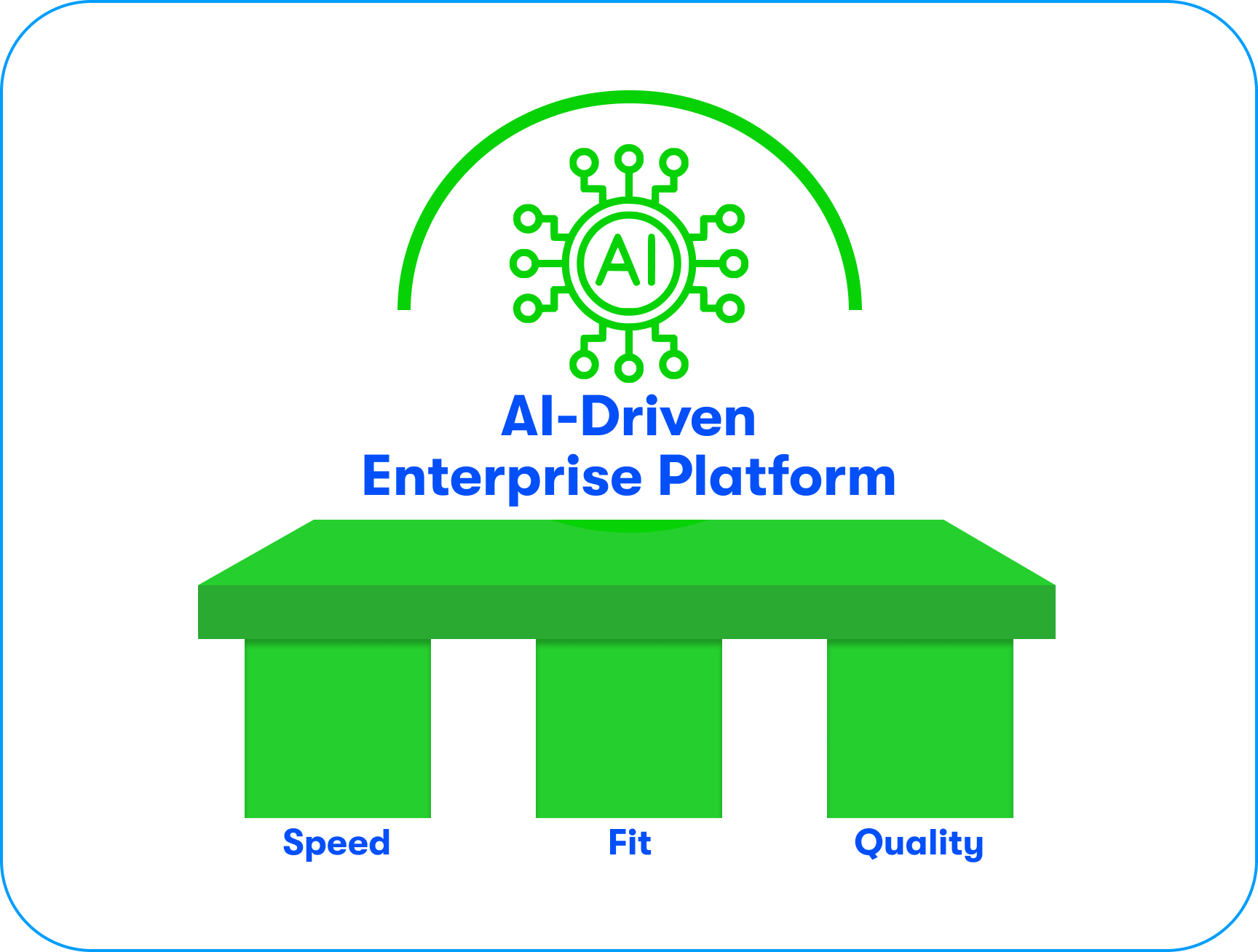
This model beats traditional SaaS plus AI add-ons because it allows organizations to build exactly what they need, achieve SaaS-like speed, and maintain full control and enterprise quality. AI development is not an experiment or an add-on but a new software construction standard that combines speed, fit, and security. Modern AI deployments increasingly rely on driven development, where key processes are powered by artificial intelligence. This enables optimization, management, and control at every project stage, as well as better identification of potential problems, risks, and technical constraints. Organizations can work together, continuously improving processes (continuous improvement), ensuring solution consistency, and eliminating major challenges related to legacy system modernization. Thanks to AI-Driven Development, companies achieve real business value, noting increased developer productivity, reduced project completion times, and higher user satisfaction rates. Thanks to generative AI, the IT industry transformation accelerates, allowing automation, optimization, and rapid scaling of AI solutions.
Companies choosing this approach and the right partner will gain a competitive advantage through faster value delivery, better resource utilization, and higher security levels.
What should you pay attention to in order to effectively leverage the potential of AI in your organization?
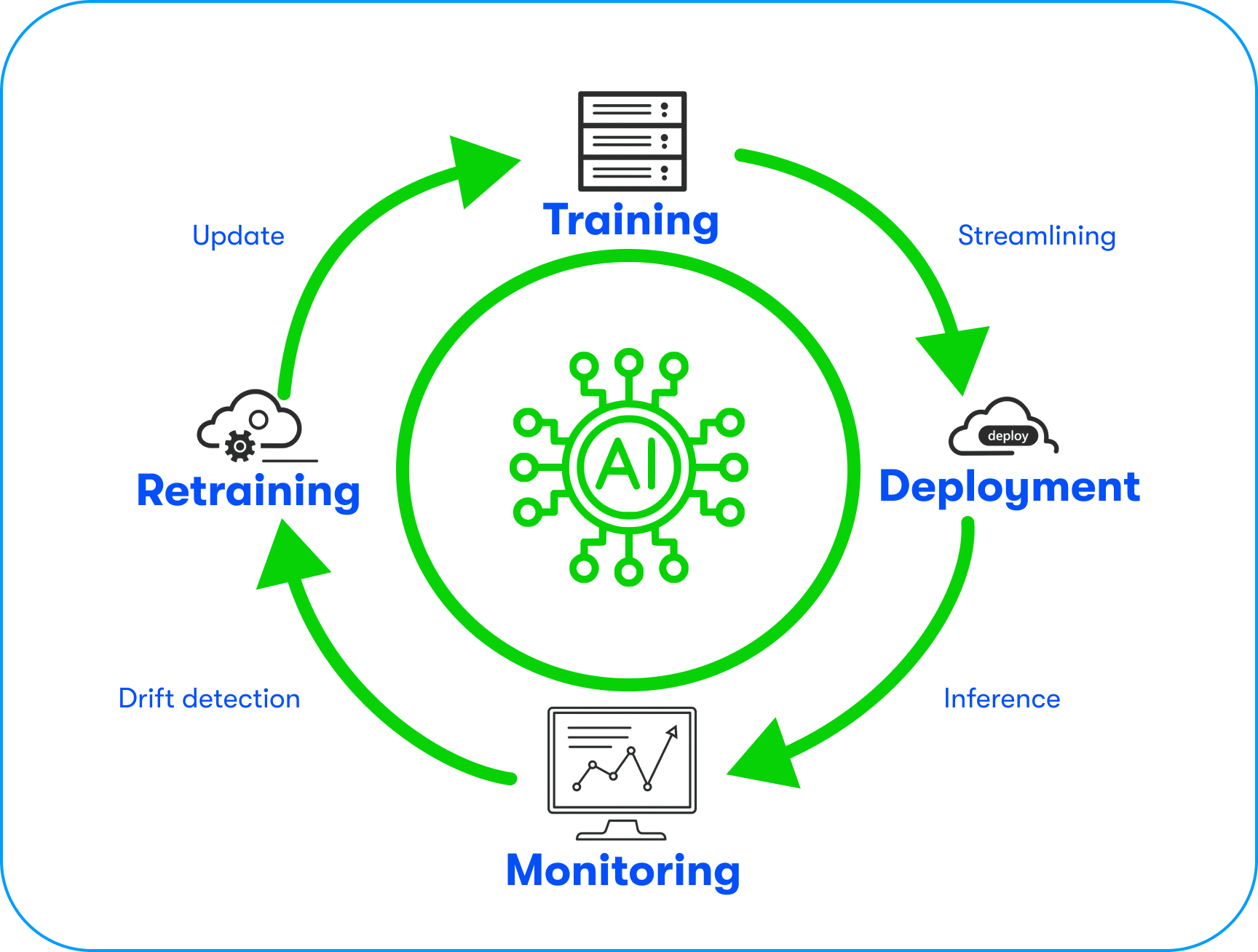
Implementing AI-based solutions is not only a matter of choosing the right technologies, but also of effectively monitoring and managing AI models. It is crucial to track key performance indicators (KPIs) that allow you to assess whether the models are working as intended and delivering real business value. The most important metrics include:
- model accuracy,
- precision and sensitivity,
- data access patterns,
- user engagement metrics,
- latency and throughput for real-time inference.
Real-time monitoring enables data science and operations teams to quickly detect changes in performance, identify potential issues, and respond to changes in business processes or customer behavior. This proactive approach helps avoid unplanned downtime, reduce errors, and ensure that AI solutions remain aligned with business objectives.
Summary
AI development is a revolution in software creation that allows combining SaaS speed, custom software flexibility, and enterprise quality. Modern AI deployments require not only innovative technologies but also effective management, control, and process optimization to ensure real business value. Thanks to the driven development approach, continuous improvement, and working together with a partner, it is possible to achieve higher productivity, better control over data and processes, and continuous solution enhancement. Thanks to generative AI, the software engineering industry is undergoing a transformation that enables automation, optimization, and rapid scaling of AI solutions.
We support organizations at every AI implementation stage from architecture and integration through AI development to production deployments and long-term system development - helping achieve real business benefits. Contact us to discuss how this model can work in your company.